

Marina_Cole
Moderator
What Disney Cruise Line Employees Actually Earn: The Real Pay Structure Behind the Magic
You're standing in the atrium of the Disney Magic, watching crew members glide effortlessly through their shifts with genuine smiles. You've probably wondered: how much do these people actually make? It's a fair question, especially when you're spending $3,000+ per person on your vacation. After 40+ cruises across multiple cruise lines—including nearly a dozen Disney sailings—I've had plenty of conversations with crew members about compensation. The answer is more nuanced than you'd think, and it explains a lot about why Disney maintains such consistently high service standards.
The Base Salary Reality: It's Lower Than You'd Expect
Let's start with the uncomfortable truth: Disney Cruise Line employees don't earn what you might imagine for working on one of the world's most expensive cruise lines.
Based on crew conversations and industry data, base salaries for entry-level crew typically range from $800 to $1,200 per month—significantly lower than similar hospitality positions on land. Housekeeping staff, dining room attendants, and bar servers start at the lower end of that range. Deck crew and technical staff earn slightly more, usually $1,100–$1,500 monthly.
Here's the critical context: these wages are paid in U.S. dollars, and employees come predominantly from the Philippines, Indonesia, India, Mexico, and Eastern Europe. In those economies, these salaries represent substantially better earning potential than domestic hospitality jobs. A Disney crew member earning $1,000/month might make 2–3 times what they'd earn at a comparable position back home.
That said, this is still a low wage by U.S. standards, and Disney's crew members are working aboard a ship flying under Bahamian registry, not subject to federal minimum wage laws.
The Hidden Compensation: Room, Board, and All-You-Can-Eat Dining
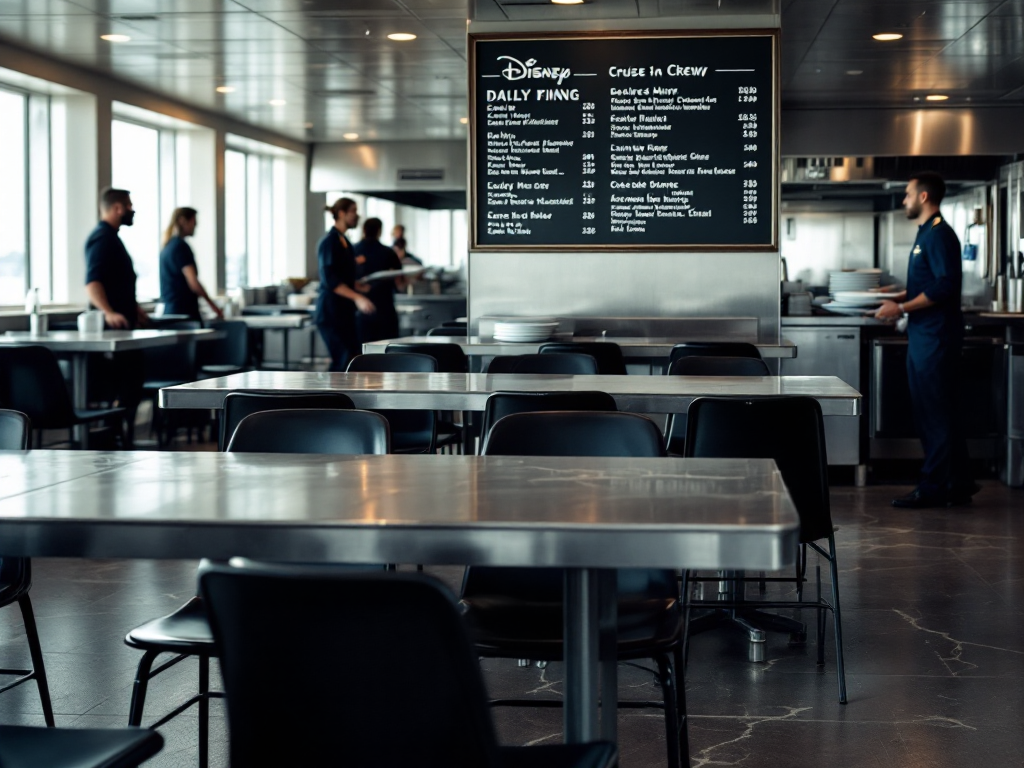
Here's where the math changes significantly. Disney—and most cruise lines—provide accommodation and meals completely free to crew members. This is enormous.
A typical crew cabin is compact (around 120–150 square feet for junior staff) but includes a bunk bed, small desk, and private bathroom. You're not paying $1,500/month in Miami rent. Senior officers get better accommodations, sometimes with their own cabin and sitting area.
Meals are included and genuinely good quality. I've eaten in crew mess areas (yes, that's allowed sometimes), and the food is far superior to what you'd expect. They have multiple meal options, fresh fruit, coffee stations, and snacks available around the clock. Disney also provides complimentary coffee, tea, and basic beverages throughout the ship.
Conservative estimate: housing and food combined represent another $800–$1,200 in value monthly. That effectively doubles the take-home value of the compensation package.
Gratuities: The Real Income Driver
Now we're getting to the part that matters most. Gratuities—tips—are where Disney crew members actually earn meaningful income.
Disney automatically adds gratuities to guest accounts at approximately $15 per person per day (as of 2026). On a 7-day cruise with 2 passengers, that's $210 in automatic tips alone, split among dining staff, housekeeping, and bar crew.
Let me break down typical gratuity distribution:
- Dining room servers: Usually receive 50–60% of the pool
- Housekeeping staff: Around 20–25% of the pool
- Bar and beverage staff: Receive tips directly from drink purchases, typically $1–2 per drink, plus gratuity pool share
- Other crew (kitchen, deck, activities): Smaller shares, but still meaningful
A dining room server on a ship with 4,000 passengers might process 200–250 covers per night. With automatic gratuities plus direct tips from specialty dining, a server can earn $1,500–$2,500 per month in tips alone—often exceeding their base salary by 200–300%.
Housekeeping staff, who maintain 600+ cabins with incredible attention to detail, typically earn $800–$1,200 monthly in gratuity splits.
Important reality check: Gratuities are paid in cash at the end of contracts. There's no safety net if guests request gratuity removal or if occupancy drops. In slower seasons, tip income decreases noticeably.
Contract Structure: The Weeks Matter
Disney crew members work on contracts, typically 4–9 months at a time, followed by paid time off at home. This is different from land-based hospitality positions.
A standard contract works like this:
- Work period: 4–9 consecutive months aboard ship
- Time off: 1–3 months at home (unpaid, but you have zero living expenses aboard)
- Turnaround: Usually 1–2 weeks to travel home and back
This means crew members work intensively for extended periods but enjoy substantial breaks. The tradeoff is no vacation days during contract—you're on call for 12 months per year effectively, though you work only 4–9 of those months.
Overtime is common but not always compensated with extra pay. Instead, crew members sometimes receive "port days" or comp time, though this varies by department and position.
Rank and Experience: How Compensation Scales
Not all Disney crew members earn the same. Here's how it breaks down by position:
Junior Positions (Entry-Level):
- Dining room attendants: $800–$1,000/month base + tips
- Housekeeping: $900–$1,100/month base + tips
- Bar staff: $1,000–$1,200/month base + significant direct tips
- Deck crew: $1,100–$1,300/month base
Mid-Level Positions:
- Head servers/section leaders: $1,300–$1,700/month + larger tip share
- Housekeeping supervisors: $1,400–$1,800/month + smaller tip share
- Kitchen staff (chefs, prep cooks): $1,500–$2,200/month base
- Bartenders (specialty bars): $1,200–$1,500/month + high direct tips
Senior Positions:
- Department heads: $2,000–$3,500/month base
- Executive chefs: $2,500–$4,000/month base
- Hotel director: $3,000–$5,000/month base
- Ship officers (captain, staff captain, pursers): $3,500–$8,000+/month base
Senior positions have better accommodations, sometimes get their own cabins, and eat in the officers' mess with higher-quality provisions.
Benefits Beyond Salary and Tips
Disney offers crew perks that go beyond typical cruise line standards:
Education Programs: Disney has partnered with universities to offer subsidized online courses. Crew members can earn certifications while working.
Onboard Amenities: Crew members receive free or heavily discounted access to gyms, internet (limited), and entertainment. Some departments get free meals in specialty restaurants during crew appreciation events.
Medical & Dental: Basic medical care is provided aboard (no cost). Dental and vision vary by country of origin and employment status, but Disney generally covers emergency care.
Flight Repatriation: Unlike some cruise lines, Disney covers the cost of flights home at the end of contracts—substantial savings.
No Uniform Costs: Disney provides uniforms, laundry, and maintenance at no charge to crew.
Crew Recreation: Access to crew bars, gyms, and social events. The crew areas on Disney ships are genuinely nice—not luxurious, but comfortable.
The Hidden Costs and Challenges
Before you feel sorry for or celebrate Disney crew members, understand the real costs:
Cabin Sharing: Most junior crew share cabins with roommates. Privacy is minimal. You're essentially living in a dorm.
Limited Personal Space: You're confined to a ship with the same 1,200–1,400 crew members for months. Relationships get complicated. Mental health support is available but limited.
Family Separation: 4–9 months away from family. This is the biggest emotional cost.
Work Hours: There's no such thing as 8-hour shifts in cruise hospitality. Servers work double shifts during heavy occupancy. Housekeeping works 12–14 hour days on turnaround days. You're working when passengers need service, not on a fixed schedule.
Limited Internet: Crew internet is restricted, slow, and sometimes paid. You might get 1–2 hours of Wi-Fi daily if you're lucky.
Disciplinary Structure: Crew operates under maritime law. Violations can result in immediate termination and deportation, with flight costs deducted from final paychecks. It's harsh.
How This Compares to Other Cruise Lines
I've interviewed crew from Royal Caribbean, Carnival, Princess, and Norwegian as well. Disney crew actually earn comparably to—or slightly better than—other premium lines.
What sets Disney apart isn't higher wages but more consistent occupancy and higher gratuity standards. Disney ships sail fuller, guests tip more generously, and there's less volatility in income. That stability is worth something.
Carnival crew members might earn similar base pay but face more occupancy swings. Norwegian crew members sometimes earn slightly more but work on newer ships with higher operating costs. Royal Caribbean offers better advancement opportunities but with longer contracts.
Why This Matters for Your Disney Cruise
Understanding crew compensation changes how you experience your Disney cruise:
Respect the work: When your server remembers your drink order or your housekeeper leaves a towel animal, that's not magic—it's professional excellence built on sustainable work. Acknowledge it.
Tip appropriately: The automatic gratuity is fair, but if service exceeds expectations, additional tips genuinely change lives. $20–30 cash in an envelope to a server over a week means real money in their home country.
Don't make their job harder: They're working long hours in a confined space. Kindness costs nothing and is noticed.
Consider the context: If service is slow or something goes wrong, it's rarely the crew member's fault. Staffing decisions and corporate policies are what they are.
The Bottom Line
Disney Cruise Line employees earn modest base salaries ($800–$1,200 entry-level) but effectively double that through gratuities and complimentary room and board. Senior positions command more competitive wages. Overall, it's a reasonable compensation package for the international workforce Disney employs, though it represents below-market wages by U.S. standards.
The real question isn't how much Disney crew make—it's whether you, as a passenger, value the service you receive enough to acknowledge that value. Because when you're having the time of your life on a Disney cruise, someone just off your balcony is working a 12-hour shift in a room the size of your bathroom to make it happen.
They deserve respect. And they deserve a tip.
Have conversations with crew members during your Disney cruise—they have incredible stories. Learn more about the Disney Cruise Line experience and connect with other passionate cruisers in the CruiseVoices Disney Cruise Line forum. Share your crew interactions, ask questions, and discover insider tips from experienced Disney cruisers.