

Jake_Harmon
Moderator
Do Walkie Talkies Even Work on a Cruise Ship?
Let me be straight with you: this is one of the most common questions I get from cruisers planning their trips, and the answer isn't as simple as "yes" or "no."
The truth is, most standard consumer walkie talkies will NOT work reliably on a cruise ship. Why? Because cruise ships operate in what's called "international waters" once they leave port, and the radio frequencies that work on land (like FRS and GMRS bands in North America) are heavily regulated or completely blocked at sea. The ship's communication infrastructure is designed to prevent interference with maritime safety systems, and that means your typical Walmart two-way radios become expensive paperweights pretty quickly.
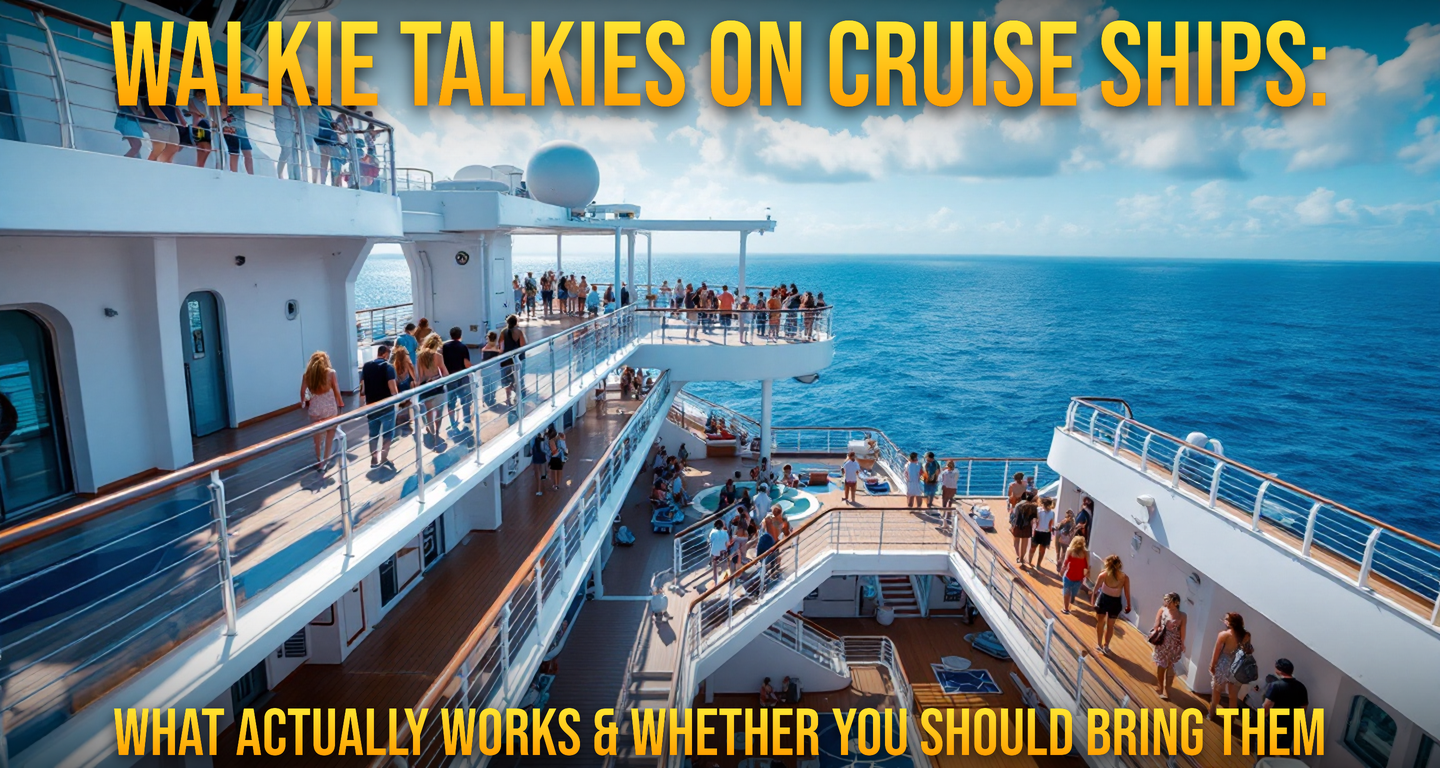
I've brought walkie talkies on at least 15 cruises, and I've learned this lesson the hard way. The first time, I packed two brand-new Midland FRS radios thinking I'd stay in touch with my travel buddy when we split up during port days. Spoiler: they barely worked even while docked, and they were completely useless once we sailed away.
Which Walkie Talkies Actually Work (And Which Don't)
The Bad News: Standard Consumer Models
- FRS (Family Radio Service) walkie talkies — These are the most common type you'll find, brands like Motorola Talkabout or Uniden. Range is typically 1-2 miles under ideal conditions, but on a cruise ship? You're looking at maybe a few hundred feet, and that's if you're on the same deck with clear line of sight. Once you go below deck, signal drops dramatically. Cruise ship hull construction doesn't play well with radio waves.
- GMRS (General Mobile Radio Service) radios — These are slightly more powerful than FRS (requiring a license in the US, though most people don't bother) but face the same ship-related problems. Range might improve slightly, but you're still limited by the metal structure of the vessel.
- Marine band handheld VHF radios — Here's where it gets interesting. A proper marine VHF transceiver (like a Garmin inReach Mini or Icom IC-M25) will technically work on a cruise ship if the ship allows it. Many don't. Most cruise lines forbid personal marine VHF radios because they can interfere with the ship's navigation and safety systems. Norwegian Cruise Line and Royal Caribbean explicitly prohibit them in their prohibited items lists. Carnival's policy is less clear, but I wouldn't risk it.
- Satellite communicators — Devices like the Garmin inReach or Apple Emergency SOS via Satellite sound amazing, but here's the catch: they don't work inside the ship at all. You need clear sky visibility, which means being on an open deck or at least near a window. For a $400 device, that's a pretty limited use case on a cruise.
The Real Question: Do You Even Need Them?

Here's my honest take after 40+ cruises: you probably don't.
I know that sounds harsh, but stay with me. Modern cruise ships are incredibly social environments where you're constantly seeing the same people — your cabin neighbors, people at dinner, folks at the main pool. If you and a travel companion want to split up during a sea day to explore different areas of the ship, you can always set a meeting point and time. "Meet me at the Lido Deck pool at 2 PM" works just fine.
For port days, though, this is where people think they need walkie talkies most. If you're booking a shore excursion through the cruise line, everyone gets back on the bus at the same time — no communication needed. If you're doing your own thing in port, your smartphone is your best friend. Almost every cruise port in 2026 has cellular coverage, and you can either:
- Text or call each other using your phone's standard service (roaming rates apply, but they're usually reasonable)
- Use WhatsApp, iMessage, or Messenger over WiFi if the port has public WiFi
- Rely on the ship's WiFi (which works in most ports)
I've literally never needed a walkie talkie for port coordination, and I've been to 120+ ports across 40+ cruises.
Specific Situations Where Walkie Talkies Might Make Sense
There are a few edge cases where they could be helpful:
- Multi-cabin family trips where everyone needs hands-free coordination — If you have 3-4 cabins scattered across different decks and want to coordinate group meetings without cell phone charges, walkie talkies theoretically work. In practice, though, they only work reliably on the same deck with clear line of sight. Honest truth: I've never seen this work well on a ship.
- Families with young kids on sea days — Some parents bring basic FRS radios to stay in touch with their kids if they're old enough to be semi-independent (think teens). This is probably the most practical use case I've encountered. A parent can be at the gym while a teenager is at a different pool area, and they can quickly check in. Even then, range is unpredictable.
- Special circumstances like large group cruises — If you're sailing with 50+ people and organizing multiple group activities, you might coordinate with 1-2 "leaders" using walkie talkies. But honestly, a group chat works better and doesn't depend on radio frequencies.

If You Decide to Bring Them Anyway: What to Actually Pack
I'm not here to tell you not to bring walkie talkies — I'm just being honest about their limitations. If you want to bring them, here's what I'd recommend:
Best Options for Cruise Ships
- Motorola Talkabout T600 (around $80-120) — Durable, waterproof, good battery life. Not going to work great on the ship, but if you're testing range on a sea day, these are reliable. I've used them for deck-to-deck communication and gotten maybe 200-300 feet of usable range indoors.
- Midland X-Talker T77 (around $50-70) — Budget-friendly option. Works about as well as the Motorola at a lower price point. Not fancy, but reliable within its limitations.
- Garmin inReach Mini 2 (around $400) — This is completely different from traditional walkie talkies. It uses satellite communication, which does work at sea. The catch? It only works if you're outside on deck with clear sky visibility. You can send location-based messages and coordinates. It's genuinely useful for cruisers who also do land adventures, but it's pricy for occasional cruise use.
Skip the "maximum range" marketing claims. Manufacturers tout 20-30 mile ranges, but that's theoretical best case. On a cruise ship with metal walls and interference from the ship's electronics, expect 1/10th of that in the best case.
What You Need to Know Before Packing
Check your cruise line's prohibited items policy. Here's what I found for 2026:
- Royal Caribbean — Prohibits two-way radios and walkie talkies. Full stop.
- Carnival — Doesn't explicitly mention them, but their policy says "no items that interfere with ship operations." FRS radios are probably technically allowed, but I wouldn't push it.
- Norwegian Cruise Line — Specifically prohibits walkie talkies. Marine VHF radios also forbidden.
- Disney Cruise Line — Not mentioned in the standard prohibited items list, which suggests they might be okay, but I'd contact DCL directly before sailing.
- Celebrity Cruises — No specific mention, but general policy discourages anything that could interfere with ship communication.
- Princess Cruises — Similar to Carnival — not explicitly prohibited, but risky.
Honest advice: call your cruise line and ask before packing them. A 5-minute phone call saves you the embarrassment of having them confiscated at embarkation.

The Hidden Reality: Why They Disappoint Cruisers
I've watched dozens of cruisers bring walkie talkies and then barely use them after the first day. Here's why:
- People forget to charge them — You're on vacation. Walkie talkie charging isn't top of mind. Batteries die. Then what?
- Unpredictable ship interference — The ship's radar, navigation systems, and hundreds of electronic devices create interference that kills signal. It's not consistent, which makes it maddening. One moment you get a clear signal, the next moment it's static.
- They encourage weird communication habits — People get self-conscious talking into a radio at the pool. It feels bulky and touristy. Your phone is sleeker and doesn't draw attention.
- Cruising is about going WITH people, not staying dispersed — If you're traveling with someone, part of the joy is being together. If you're splitting up frequently enough to need radios, maybe you should ask why you're cruising together?
I say that last one with love, not judgment. I've split up with travel companions on port days, and we just texted. It worked great.
The Bottom Line: My Honest Recommendation

After 40+ cruises, here's what I actually do:
I don't bring walkie talkies anymore. I bring my phone, make sure I have an international data plan (usually $10-15 per day through my carrier), and rely on cellular service and WiFi. It costs less than a pair of decent walkie talkies, it's more reliable, and it integrates with every app I'm already using.
For families with teenagers, I might make one exception and bring a pair of basic FRS radios (something under $50) as a backup communication method, knowing they're limited to close-range, same-deck communication. But it's a backup, not the primary plan.
For any situation where you're thinking "walkie talkies would be perfect for a cruise," I promise you that texting, meeting at pre-arranged times, or using your phone will actually work better and stress you out less.
If you're still set on bringing them, go with a budget option from Motorola or Midland (under $100 total), test them on a sea day to see their actual range on your specific ship, and don't be surprised when they underperform. Have a phone backup plan ready to go.
Share your walkie talkie experiences — successes and failures — in our CruiseVoices general discussion forum. I'd love to hear if anyone's had better luck than I have with these things!