

Drew_Callahan
Moderator
The Real Science Behind Ship Motion and Cabin Placement
After 40+ cruises, I can tell you the #1 question I get from first-timers is about seasickness. And honestly? Most of the advice you'll find online is either oversimplified or just wrong. The relationship between cabin location and motion sickness isn't just about "midship is always best"—it's way more nuanced than that, and it depends heavily on your ship's size, design, and the itinerary you're sailing.
Let me break down what actually happens when a ship moves through water, and then I'll show you exactly where to book your cabin based on real physics and real experience.
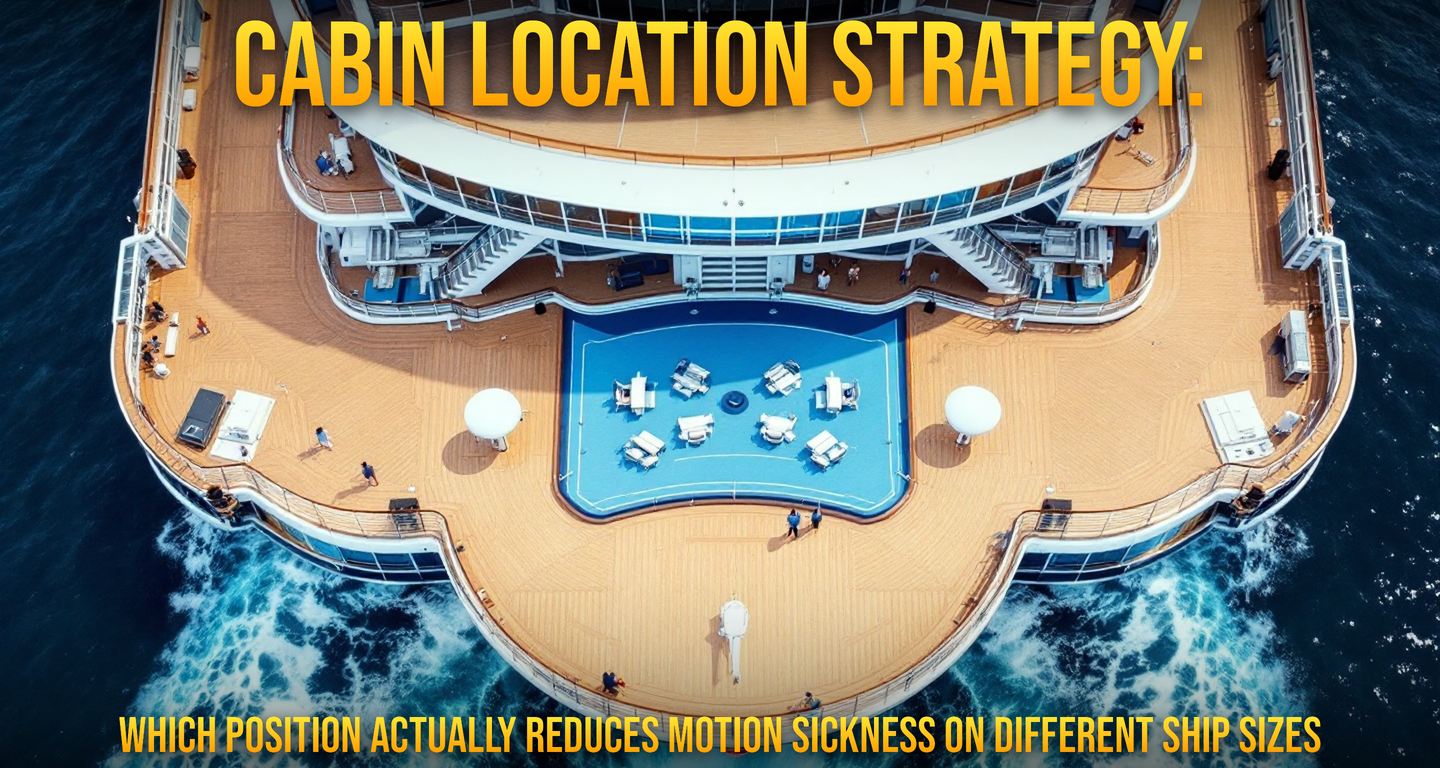
Understanding Ship Motion: The Physics That Matters
Ship motion happens in three directions: heave (up and down), pitch (front to back tilting), and roll (side to side tilting). Different locations on the ship experience these motions very differently.
When a ship moves through a swell, the midship area (roughly the center width of the ship) experiences less roll because that's the ship's pivot point. Think of a seesaw—the center moves up and down least dramatically. Forward and aft cabins rock more side to side.
But here's what most guides miss: heave and pitch affect forward and aft cabins differently. The forward section (bow) dips into waves and rises sharply—that's more pronounced motion. The aft section (stern) also moves but in a different pattern because it's further from the pivot point and experiences more of the wave energy after the ship has already passed over it.
Middeck cabins? They do move, but it's primarily vertical (heave) rather than the rolling and pitching that triggers motion sickness in most people.
Why Ship Size Changes Everything
This is crucial: motion sickness strategy is completely different on a 5,000-passenger mega-ship versus a 2,000-passenger vessel.
Mega-Ships (3,500+ passengers)
On ships like the Royal Caribbean Oasis-class (Wonder of the Seas, Icon of the Seas) or Disney's newest vessels, the ship is so massive that you genuinely feel less motion overall. These ships are 1,100+ feet long and weigh 230,000+ tons. They cut through swells rather than ride them. For these ships, midship cabins on middle decks (typically Decks 6-8 on a 16-20 deck ship) are your best bet. The motion is minimal, and the heave is less noticeable because the ship is so wide and stable.
On mega-ships, I'd actually avoid premium suites in the very aft if you're sensitive to motion. Those Sky Suites and aft-facing cabins on Royal Caribbean's Oasis-class can feel surprisingly rocky during rough seas because the stern experiences more pitch and can sometimes feel a bit "whippy."
Large Ships (2,000-3,500 passengers)
This is where cabin location strategy really matters. Ships like the Carnival Vista (3,954 passengers), Norwegian Escape (4,254 passengers), or Celebrity Edge (2,918 passengers) are large enough to be stable but small enough that you'll actually feel the difference between cabin locations.
For these ships, midship, middle decks is genuinely your safest bet. On a ship with 14 decks, I'd target Decks 5-8 in the midship section. Not the very bottom decks (engine vibration and noise), not the top decks (more motion amplification at height), and definitely not forward or aft if you're prone to seasickness.
On the Carnival Vista, for example, Deck 6 midship is noticeably more stable than Deck 11 forward. I've been in both, and the difference is real.
Smaller Ships (under 2,000 passengers)
Here's where it gets interesting. Smaller ships like the Disney Magic, Norwegian Joy (when configured as a smaller vessel on certain itineraries), or expedition ships move more overall, but the motion is more uniform across the ship because there's less ship to pivot.
On smaller vessels, midship still wins, but the advantage is less dramatic. What matters way more on smaller ships is choosing a lower deck. Gravity works in your favor—motion is felt more acutely on higher decks. If you're on a 12-deck ship and prone to seasickness, Deck 3-4 midship beats Deck 10 midship every single time, even if Deck 10 is technically midship.
Breaking Down Each Cabin Position
Forward Cabins (Bow)
Forward cabins experience the most pitch—that front-to-back rocking. When the ship encounters a swell head-on, the bow rises sharply and then drops. If you've ever sat in the front row of a roller coaster, you get it. Forward cabins are cheaper for a reason, and if you're motion-sensitive, that discount isn't worth the trade-off.
I had a balcony cabin on Deck 8 forward on the Carnival Breeze (a Vista-class ship) a few years back. On the first rough sea day in the Gulf of Mexico, I felt the entire nose of the ship dip and rise every 8-10 seconds. It was honestly unsettling. The cabin was gorgeous and cost $300 less than midship, but I didn't sleep well that night.
Forward cabins are also noisier—you'll hear the anchor system, the thrusters, and water sloshing against the bow.
Midship Cabins (Center of Ship Width)
This is the sweet spot for motion sensitivity. Midship cabins experience primarily vertical heave (up and down), which your body tolerates far better than lateral rolling. The heave motion is gentle and rhythmic—it actually puts some people to sleep.
For mega-ships, any midship cabin on a middle deck works well. For larger traditional ships, target Decks 5-8 midship. For smaller ships, prioritize lower midship decks (3-5) over higher ones.
The only downside? Midship cabins book up fast and sometimes cost more because everyone knows they're the best for seasickness prevention. But honestly, it's worth the extra $200-400 for a week if you're motion-sensitive. You'll actually enjoy your cruise instead of spending it in your cabin.
Aft Cabins (Stern)
Aft cabins get a bad reputation, but the reality is more nuanced. The stern does experience more pitch than midship, especially in heavy seas, but it's different from forward. Instead of a sharp dip-and-rise, the stern experiences more of a sustained tilting motion as the stern rides up and over swells.
Aft cabins are often quieter than forward cabins and can feel less chaotic. The downside? On rough sea days, the stern can feel like it's being lifted and dropped repeatedly. I've been in aft cabins where the motion was surprisingly gentle, and others where I felt every wave.
My rule: avoid aft cabins if you're very motion-sensitive. They're great for quiet location and often have interesting views, but the motion trade-off isn't worth it. However, if you just get slightly queasy in heavy seas, aft cabins on larger ships are often fine.
The Deck Height Factor You Can't Ignore
Most guides talk about fore/midship/aft but ignore the vertical factor. Here's the truth: lower decks feel less motion than higher decks.
Physics: Motion is amplified at greater distances from the ship's center of gravity (which is roughly at the waterline). A cabin on Deck 2 will feel noticeably less motion than the same location on Deck 12.
This matters especially for smaller ships and for people with serious motion sensitivity. If you're choosing between Deck 8 midship and Deck 4 midship, go lower. The difference is real.
However—and this is important—don't go too low. Decks 2-3 can have engine noise and vibration on some ships. Deck 4-6 is usually the sweet spot: low enough to minimize motion, high enough to avoid technical noise.
On the Disney Magic, for example, Deck 5 midship is genuinely better than Deck 9 midship for seasickness. I've had both cabins on different sailings, and Deck 5 was noticeably calmer in rough seas.
Special Cases: Balconies, Suites, and Hidden Gems
Balcony Cabins and Motion
Balcony size doesn't matter for motion, but location absolutely does. A midship balcony cabin is still great for motion sensitivity. A forward balcony? Still not ideal. Don't choose your cabin based on balcony size if you're motion-prone—location trumps amenities.
Suites and Premium Cabins
Premium suite locations vary by cruise line. On Celebrity Cruises, the Sunset Suites are aft on higher decks—not ideal for motion sensitivity. On Royal Caribbean, suite cabins span the ship, so location matters just as much as it does for regular cabins. Just because it's an expensive suite doesn't mean it's in a stable location. Read the deck plan carefully.
Cove Cabins and Newer Specialty Staterooms
Carnival's Cove Balcony cabins are positioned forward-midship, which is a compromise: not as forward as true bow cabins, but forward of true midship. They're fine for people with mild motion sensitivity but not ideal for severe sufferers. These cabins are also priced as a premium product, so you're paying extra partly for novelty, not stability.

Itinerary and Ship Motion: When Location Matters Most
Here's something nobody tells you: your itinerary matters as much as your cabin location.
Calm Water Routes (2026)
If you're sailing the Mediterranean in summer 2026 or a Caribbean route during calm season, even a forward cabin is fine. The seas are flat, and motion is minimal everywhere on the ship.
Rough Water Routes
Alaska, transatlantic, and Northern European routes in fall 2026 have rougher seas. Here, cabin location strategy is critical. A forward cabin in the Gulf Stream during an October transatlantic crossing? You'll wish you'd paid for midship.
The Bermuda Triangle and Atlantic Swells
Bermuda and Caribbean itineraries departing from US East Coast ports encounter Atlantic swell patterns that can kick up motion. If you're sailing from Charleston, Savannah, or Galveston in rough season, prioritize midship cabins.
Actionable Cabin Selection Strategy for 2026
Here's your step-by-step game plan:
- Step 1: Assess your motion sensitivity. Have you been seasick before? Do long car rides bother you? If either is yes, prioritize stability over everything else.
- Step 2: Know your ship class. Mega-ships are naturally more stable; smaller ships require more careful placement.
- Step 3: Target the deck range. For mega-ships: Decks 6-8. For large ships: Decks 5-8. For small ships: Decks 3-6. Adjust based on your ship's total deck count.
- Step 4: Prioritize midship location. This is non-negotiable for motion sensitivity. Accept lower cabin categories if needed to stay midship.
- Step 5: Check the deck plan before booking. Every ship is different. Review the actual layout at your cruise line's website or the Trip Planner to verify midship section boundaries.
- Step 6: Ask about current seas. When you book, your travel agent (or our deck plans and room locations community) can help you understand the itinerary's typical wave patterns.
- Step 7: Consider the upgrade cost. If a midship cabin costs $300-600 more than a forward cabin, it's usually worth it. You'll sleep better and actually enjoy your cruise.
What NOT to Do (Lessons from Real Cruises)
Don't assume suites are better located than standard cabins. I've seen aft suites with worse motion characteristics than midship inside cabins. Location beats category.
Don't rely on balcony size to indicate stability. A huge aft balcony is fun but rocks more than you'd expect.
Don't book forward cabins for the "view" if you're motion-prone. The novelty wears off fast when you're feeling queasy.
Don't ignore cabin accessibility features as a proxy for location quality. ADA-accessible cabins are scattered throughout the ship and don't necessarily have better motion characteristics.
Don't assume the cheapest cabin is forward. Some cruise lines price inside cabins lower than forward outside cabins. Smart move: choose an inside midship cabin over a forward balcony if you're sensitive.
Booking Your Perfect Cabin in 2026
Once you know which deck and location you want, use CruiseVoices' AI concierge and Trip Planner to see real cabin inventories and pricing in real time. Our platform lets you view deck plans, filter by location, and book instantly—without paying extra. You'll get commission-free pricing and expert guidance on exactly which cabins have the best track records for motion comfort.
Our community has also spent thousands of nights on cruise ships across every ship class. If you want to discuss specific cabin recommendations or share your own motion sensitivity experiences, join the deck plans and room locations forum—you'll get answers from real cruisers who've tested these strategies firsthand.
The bottom line? Cabin location matters, but you're not doomed if you end up forward. Midship, middle-to-lower decks is your best insurance policy against seasickness. Book there, pack some ginger supplements just in case, and focus on enjoying your cruise instead of worrying about the waves.
See you at sea!
—Sunny Shores
Share your favorite stable cabin locations and motion sickness solutions in our deck plans and room locations community!