

Sofia_Reyes
Moderator
Cruise Mistakes I Made So You Don't Have To: Confessions from 40+ Cruises
After more than four decades at sea, I've learned that the best cruise education comes from screwing up. I've wasted money on things I didn't need, missed ports because I misjudged timing, booked cabins I regretted, and made dining decisions I'm still cringing about. But here's the good news: you don't have to repeat my mistakes. I'm laying it all bare so you can cruise smarter, happier, and with more cash in your pocket.
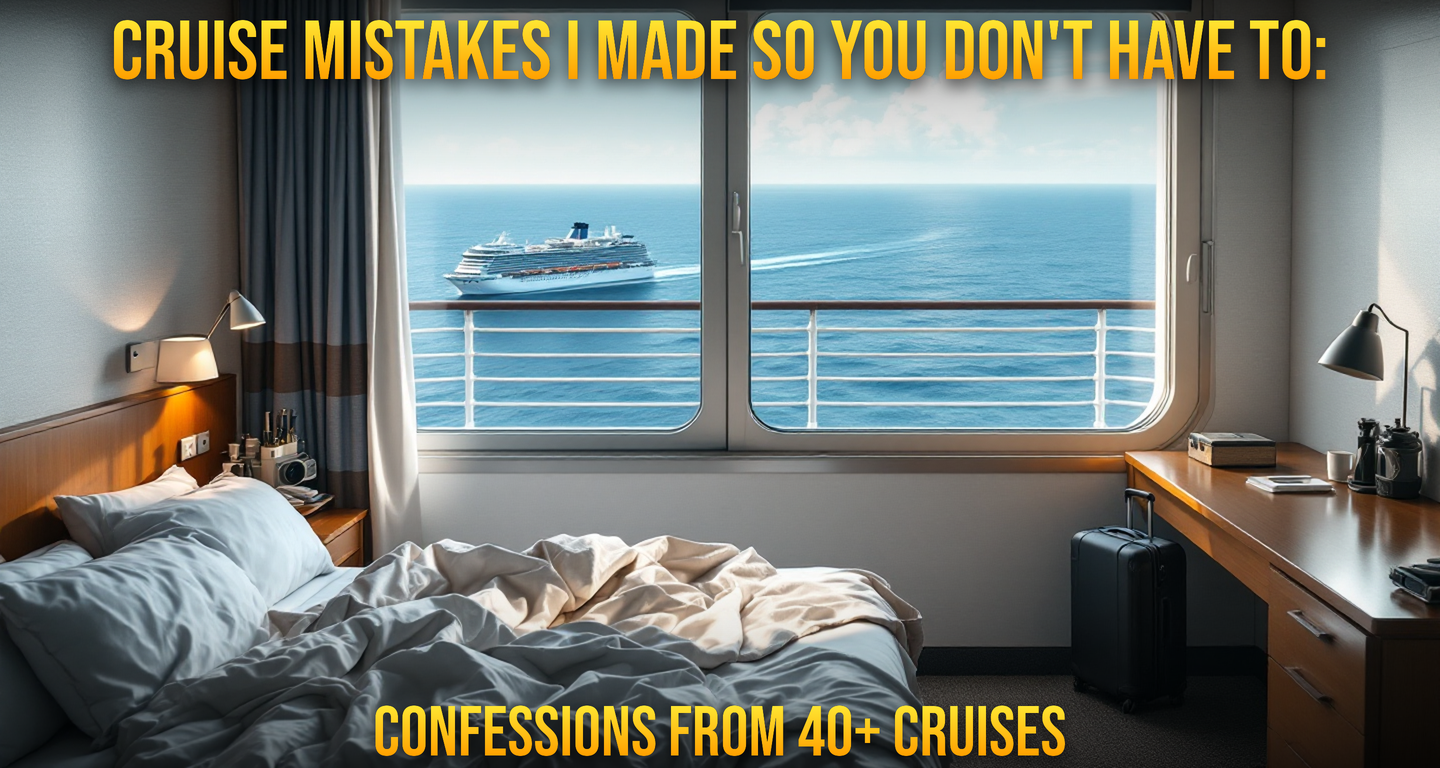
Booking the "Perfect" Cabin Without Seeing the Ship Layout First
I once booked a cabin on the Celebrity Millennium because it had a balcony and was priced reasonably. Sounds great, right? Wrong. I didn't check the deck plan closely enough and ended up on Deck 4, directly above the nightclub. I spent three nights listening to bass until 2 AM and watching drunk passengers stagger below my window.
Here's what I wish I'd done: Download the actual deck plans (not just thumbnail images) and look at your specific cabin number. Check what's nearby — engines, elevators, nightclubs, dining rooms. Read reviews on specific deck locations. On my last cruise with Royal Caribbean, I spent 20 minutes studying the Oasis-class deck plan and selected a cabin on Deck 8, toward the middle of the ship, away from the stern (which rocks more in rough seas). Night and day difference.
Also, I used to think midship cabins were boring because they don't have views. But they're the most stable in bad weather, closest to the elevators, and away from engine noise. Sometimes the "boring" choice is the smart choice.
Overpacking Formal Dining Clothes (When I Never Wear Them)
I packed two tuxedos for a 7-day cruise. A tuxedo. On a cruise where I knew 90% of my time would be in shorts and flip-flops. I wore one to the elegant dinner on night two and felt overdressed. The second one never left my cabin.
The real mistake wasn't bringing formal wear — it was not being honest with myself about how I actually spend my evenings. Most modern cruise lines have relaxed their dress codes significantly in 2026. Main dining rooms offer casual nights (jeans and nice shirts are fine), and specialty restaurants vary by line. Norwegian Cruise Line is the most casual; Disney has family-friendly elegant nights; Royal Caribbean falls somewhere in the middle.
My rule now: Pack one nice outfit for the captain's dinner (if you want to go), and stick to resort casual everything else. You'll fit in fine, and you'll have more suitcase space for things that actually matter.
Not Booking Specialty Dining Reservations in Advance
On my 15th cruise, I assumed I could just waltz into the Italian restaurant on any night and get a table. Nope. They were booked solid, and I ended up eating in the main buffet for the fifth night in a row.
Specialty restaurants on most cruise lines require advance reservations — ideally made before you board (or immediately when you get onboard). Royal Caribbean charges extra for restaurants like Giovanni's Table and Wonderland. Norwegian has specialty dining as part of their beverage packages. Disney charges per person per restaurant.
The insider move? Check your cruise line's app as soon as your booking opens online. Reserve your favorite specialty restaurants immediately. You can always cancel later if plans change.
Buying Overpriced Drink Packages I Didn't Use
I bought an unlimited drink package for $65 per person per day on a Royal Caribbean cruise and drank maybe three beverages a day. I paid $455 for drinks I barely touched while my neighbor nursed the same cup of coffee all morning. Absolute waste of money.
Drink packages make sense if you're actually drinking — cocktails cost $12-15 each at sea, so packages break even around five drinks per day. But if you're a light drinker, a coffee drinker, or someone who nurses one piña colada by the pool, don't buy it. Order à la carte or bring pre-cruise drinks if your cruise line allows them (policies vary widely in 2026).
What I do now: I track how many paid drinks I actually order in the first 24 hours. If I'm drinking 5+ drinks daily, I upgrade to the package. If not, I skip it and order selectively.
Skipping Travel Insurance (Until I Really Needed It)
For years, I thought travel insurance was a scam. Then on cruise number 22, my mother got seriously ill the week before my scheduled Royal Caribbean sailing. I had to cancel, and I lost $2,400 in deposits because I had no coverage.
Since then, I've bought travel insurance on every cruise — especially multi-day voyages. Good policies cover trip cancellation, medical emergencies, evacuation, and lost luggage. They typically cost 5-10% of your cruise price and have saved me money on at least three occasions (delayed flights, unexpected family emergencies, a missed connection that would've cost me an entire port day).
Buy it through a reputable provider or directly from your cruise line. Read what's actually covered. Some policies exclude "pre-existing conditions" unless you buy within 14 days of your initial booking deposit.
Booking Excursions Through the Cruise Line Without Comparing
I used to book every shore excursion through the cruise line's onboard program because it felt safe and convenient. Then I realized I was paying 30-50% premiums for that convenience.
A snorkeling excursion in Cozumel that the cruise line listed for $89 per person? I found the same tour through an independent operator for $55. Same boat, same guide, same experience — just a different booking method.
What I do now: I research excursions 2-3 weeks before cruise day using sites like Viator, GetYourGuide, and local tourism boards. I compare prices, read reviews, and book independently when it makes sense. For brand-new or complex excursions, I might pay the cruise line premium for their guarantee (if your excursion is late, the ship won't leave without you). But for straightforward activities? Shop around.

Arriving at the Port at the Last Possible Minute
I've made this mistake twice. Both times, I was stressed, rushing, and barely made it to my assigned sailing time. Once, I had to sprint from security with my boarding pass in hand while crew members watched nervously.
Cruise lines typically ask you to arrive 2-3 hours before departure. I used to think that was excessive. Now I arrive 4-5 hours early (especially on busy ports like Galveston or Miami). Here's why:
- Security and check-in lines are long, especially on embarkation day
- You have time to find your cabin, unpack, and orient yourself
- You catch the early dinner seating if that matters to you
- You're not white-knuckling through security
- If something goes wrong with your documents, you have time to fix it
I've used that extra time to grab lunch at the port, explore the embarkation port terminal, and start my cruise relaxed instead of frazzled.
Not Checking My Cabin Before Unpacking
I once unpacked everything in my cabin, only to discover a mysterious stain on the carpet and a broken drawer latch. By the time I reported it to housekeeping, the cabin had felt "lived in," and I was less confident they'd actually fix it (they didn't).
Now, before I unpack a single item, I do a full cabin walk-through:
- Check all lights and lamps — do they work?
- Test the air conditioning and temperature control
- Look for stains, odors, or damage
- Check the safe, mini fridge, and TV
- Test the bathroom plumbing and water pressure
- Look for any previous guest's belongings or trash
If there's an issue, report it immediately with photos. Most cruise lines will move you or fix it quickly if you catch it early. Wait until day three, and they're less motivated.
Assuming All Ports Are Worth Your Time (and Money)
On a Caribbean cruise, I once spent $120 on a "beach day" excursion that turned out to be a crowded, commercialized resort beach with mediocre food. I could've taken a $15 taxi to a local beach and had a better experience for a fraction of the cost.
Here's the truth: not every port deserves every cruiser's attention. Some ports are better for shopping (Nassau, Cozumel), some for nature (Belize, Alaska), some for culture (Key West, Roatan). Do your homework:
- Check what's actually available at your port
- Read recent reviews of popular excursions
- Look at local attractions on Google Maps before you arrive
- Ask crew members and other cruisers what they recommend
- Sometimes, skipping a port and staying on the ship is the right call — especially if it's a "tender port" with long waits
On my most recent cruise, we spent a port day in Falmouth, Jamaica. The cruise line excursions were expensive and touristy. Instead, I took a $10 shared van to a local market, bought fresh fruit and jerk chicken, and spent the afternoon at a beach just beyond the cruise port chaos. Cost me $25 total, and I had an infinitely better experience than the $85 guided tour.
Not Tipping Correctly (Or at All)
I used to think tipping your cabin steward was optional. Then I read about what cruise ship employees actually earn — often minimum wage (or less) with the expectation that tips make up the difference. I felt terrible.
Now I tip every person who provides me service. Cabin stewards ($3-5 per day), wait staff, bartenders, specialty restaurant servers, shore excursion guides — they all depend on tips. On most cruise lines, automatic gratuities are already added to your bill (around $15 per person per day), but you can adjust them if service warrants it.
The mistake I made was thinking I could opt out entirely. You can, technically, but these employees are working really hard in difficult conditions. A little extra consideration goes a long way.
Booking Back-to-Back Cruises Without a Break
I thought consecutive cruises sounded efficient. Book two 7-day voyages in a row and maximize my sea time, right? By day 10, I was exhausted, the novelty had worn off, and I realized I'd paid for a lot of experiences I didn't actually enjoy because I was burned out.
Cruising is intense. You're constantly making decisions about dining, activities, and excursions. There's noise, crowds, and stimulation everywhere. If you do back-to-back cruises, build in at least one sea day between them where you don't commit to anything and just rest.
Better yet? Space your cruises out. That cruise you want to book for next month will still be there in three months, and you'll enjoy it way more.
Not Reading the Fine Print (Especially Refund Policies)
I once booked a cruise during a flash sale without reading the refund policy. Turns out the fare was non-refundable unless I bought expensive insurance. Six weeks later, a work conflict forced me to cancel, and I lost the entire booking because I didn't understand the terms.
Read the cancellation and refund policies before you book. Understand whether your fare is refundable, what happens if you cancel, and what insurance covers. Some cruises are genuinely non-refundable; others offer more flexibility. Know what you're getting into.
Your Turn to Learn From Others
The cruise community is incredibly generous about sharing what we've learned — both the triumphs and the disasters. If you've made cruise mistakes (and who hasn't?), share them in our community. Your story might save someone else from the same headache.
Join us at CruiseVoices' First-Time Cruiser Help forum to ask questions, read other cruisers' experiences, and build your knowledge before you sail. With decades of combined cruise experience in our community, you don't have to learn everything the hard way.
Happy cruising — and may your mistakes be smaller than mine.